When a Theatre Becomes a Memory Site: Akshara and the Question of Cultural Continuity
As Delhi's historic Akshara Theatre faces an uncertain future amid plans for the expansion of RML Hospital, the dispute raises a larger question: how should a modern city balance essential public infrastructure with the preservation of living cultural insitutions?
In the heart of New Delhi, beside the expanding institutional landscape of Dr Ram Manohar Lohia Hospital, stands a theatre that has accumulated more than five decades of performances, conversations, dissent, experimentation and artistic memory. Today, Akshara Theatre, established by playwright-director Gopal Sharman and actor-director Jalabala Vaidya, faces an uncertain future as the Union Government seeks possession of the land on which it stands for the expansion of RML Hospital.
At first sight, the dispute appears to concern approximately 0.762 acre of government land on Baba Kharak Singh Marg. But understood historically, Akshara presents a much larger question: what happens when the developmental requirements of a modern city encounter a cultural institution whose value cannot be measured merely by the land beneath it?
That question has now entered the Delhi High Court.
A theatre and a hospital: two forms of public purpose
The Government's case cannot be dismissed as an ordinary redevelopment proposal. The Land & Development Office under the Ministry of Housing and Urban Affairs has stated that the Akshara plot is required for the expansion of Dr Ram Manohar Lohia Hospital, including integration with the proposed CGHS Wing and Super Speciality Block.
According to the Government, the site is “critically required” and there is no feasible alternative that would allow the hospital to expand without disproportionately disrupting existing healthcare services. The argument therefore invokes a compelling public need: strengthening medical infrastructure in central Delhi for a hospital serving a very large population.
Akshara's case, however, raises another understanding of public purpose—the preservation of an institution that has operated as a cultural space for more than half a century.
The conflict should therefore not be reduced to a convenient binary of culture versus development. Hospitals are indispensable public institutions. So are the spaces through which a society produces, contests, transmits and remembers its cultural life.
The Akshara dispute is significant precisely because both claims concern the public realm.
From an international theatre journey to a Delhi home
The history of Akshara predates the present building dispute by decades.
In 1969–70, Gopal Sharman and Jalabala Vaidya travelled through Europe and Britain with their production Full Circle. Their work belonged to an early generation of independent Indian theatre that was attempting to establish a presence internationally at a time when such tours were considerably more difficult than they are today.
The success of that period also led to the creation of the work with which Sharman and Vaidya became most closely identified: The Ramayana.
Sharman developed his interpretation for the World Theatre Season in London. Jalabala initially performed the work as a solo production, embodying its many characters through voice, gesture and minimal theatrical means. It premiered in 1970 and subsequently travelled widely—to theatres and cultural institutions in Britain, Europe, North America and elsewhere—while continuing to be performed in India across generations.
Yet their lasting achievement was not only a production.
It was the creation of a place.
Akshara as an architectural instrument
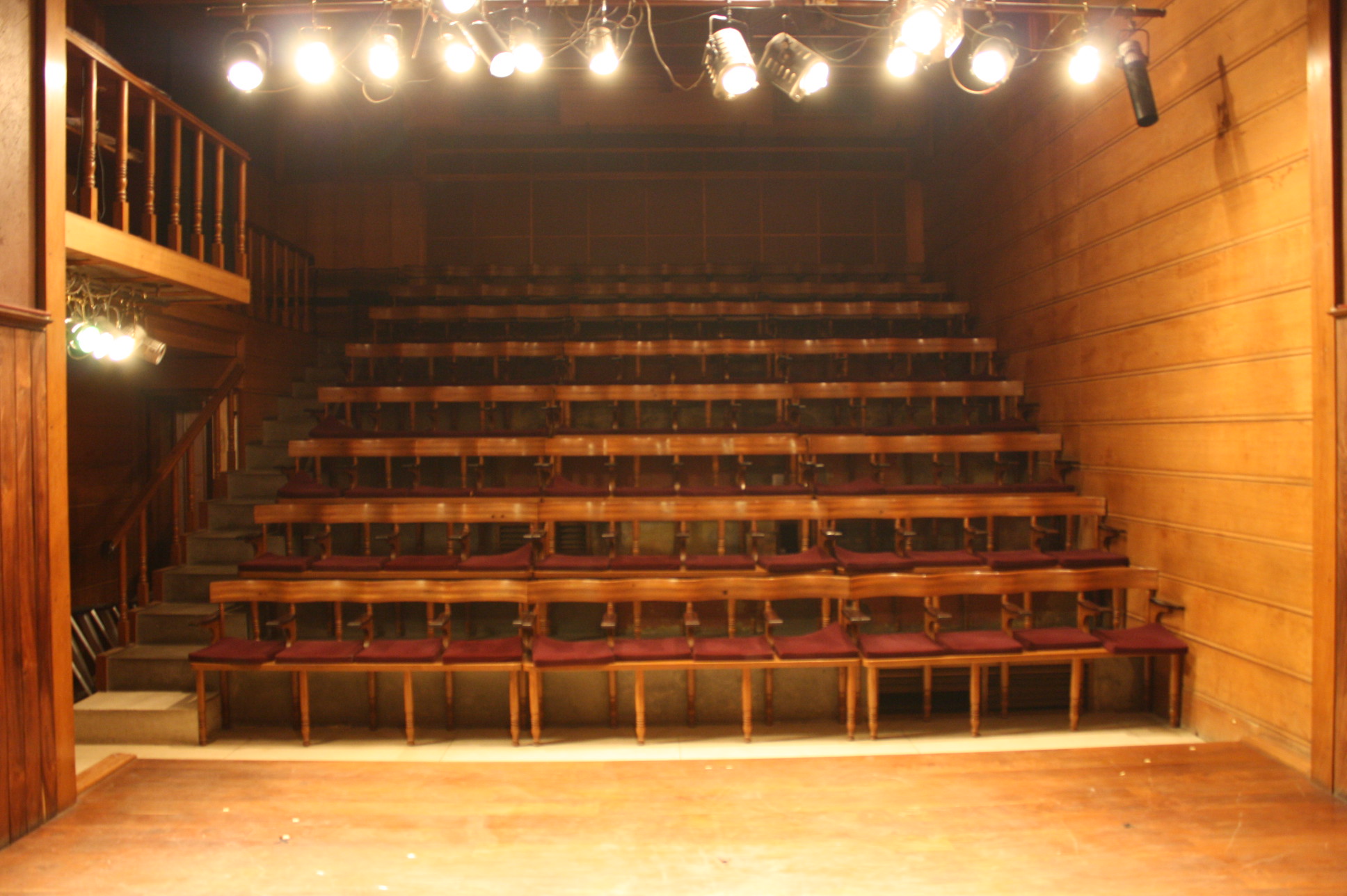
Akshara opened on 11 March 1972, initially as an intimate theatre of approximately 50 seats. The land arrangement was subsequently formalised through a perpetual lease in the 1980s, with the present lease dating from 1984. The complex was later expanded, including a significant enlargement in 1994.
The physical character of Akshara deserves attention because this is where the idea of simply “relocating” a cultural institution becomes complicated.
Gopal Sharman approached the theatre not merely as a building but almost as an acoustic instrument. Contemporary accounts describe the use of carved Dholpur stone and a stage constructed from teak and rosewood, designed to project sound towards the audience. Softer woods—including pine, cedar and deodar—were used around the auditorium to absorb it. Sharman worked with masons, carpenters and metalworkers and even designed seating for the theatre.
Architecture here was not neutral infrastructure.
It became part of the theatrical vocabulary.
Such spaces acquire meaning through an accumulation of use: the position from which an actor speaks, the distance between performer and spectator, the acoustics of a familiar auditorium, the foyer conversations after a performance, the objects constructed for productions, and the memories of audiences who return over decades.
This is why the disappearance of a theatre building cannot always be understood in the same terms as the relocation of an administrative office.
A space for dissent
Akshara's historical importance also lies in the type of theatre it was prepared to accommodate.
During the Emergency of 1975–77, Sharman and Vaidya staged the political satire Let's Laugh Again. The production mocked political authority, including Prime Minister Indira Gandhi and prominent figures of the period, at a moment when open political criticism involved considerable risk.
Accounts of the production describe audiences initially reacting cautiously before gradually permitting themselves to laugh. Its popularity eventually resulted in several performances being mounted in a single day.
The episode gives Akshara's history a particular significance.
A theatre is not culturally important merely because distinguished people have appeared on its stage. Its significance may also lie in having created a protected intellectual space in which disagreement, satire and alternative interpretations could exist.
Akshara's history repeatedly moved in this direction.
In 2013, when Pakistani productions were withdrawn from the National School of Drama's Bharat Rang Mahotsav amid India-Pakistan tensions, Ajoka Theatre's Kaun Hai Yeh Gustakh—based on Saadat Hasan Manto—was eventually performed to a full house at Akshara. Opening the theatre for that performance again asserted the idea that artistic exchange could occupy a space beyond immediate political circumstances.
An institution for artists without institutions
Perhaps Akshara's most important contribution, however, has been less spectacular and more continuous.
Large auditoria are necessary for major productions, but theatrical cultures also depend upon smaller spaces in which experiments can fail, first productions can be mounted, students can perform and unknown practitioners can encounter an audience.
Akshara increasingly served precisely this function.
Its current director Anasuya Vaidya, daughter of the founders, has described the theatre's original ambition as providing a home for artists who did not necessarily conform to established tendencies and who might not otherwise find a forum. Over the decades, college theatre festivals, young companies, experimental performers, stand-up comedians and independent practitioners have used the space.
The theatre also developed a sustained engagement with children. Workshops and performances brought generations of young participants into direct contact with theatre—not primarily as consumers of entertainment but as participants in a creative process.
This kind of cultural infrastructure is difficult to record statistically. A theatre can count performances and tickets; it is far harder to quantify the effect of giving a young actor a first stage, allowing an experimental company to afford an auditorium, or introducing a child to performance.
Yet these invisible networks are precisely how cultural ecosystems are built.
The present legal dispute
The immediate conflict began when the L&DO issued a resumption and re-entry notice on 11 March 2026, directing that possession of the premises be handed over on the ground that the land was needed for RML Hospital's expansion.
Akshara challenged the action. Proceedings were subsequently initiated before an Estate Officer under the public-premises framework.
In September, the theatre approached the Delhi High Court, objecting to the manner in which those proceedings were being conducted and contending, among other things, that it had not been given an adequate opportunity to present its case orally.
On 25 September 2026, while the High Court challenge was pending, the Estate Officer passed a final eviction order.
Justice Harish Vaidyanathan Shankar subsequently directed that the eviction order remain in abeyance. The court noted the unusual circumstances in which a final order had been passed despite the pending High Court proceedings. The interim protection does not amount to a final determination of Akshara's right to remain on the property; the underlying legal dispute is still before the court. The matter is listed again for 8 October 2026.
That distinction is essential.
Akshara has received temporary judicial protection. It has not yet secured a final victory.
A striking planning history
There is another dimension that makes the current situation particularly significant.
Official records of the Delhi Urban Art Commission (DUAC) show that plans for the demolition and reconstruction of Plot Nos. 11-B and 12-B for the Akshara National Classical Theatre of India were being considered through the formal planning system in 2023.
After revisions to an earlier proposal, the Commission recorded the scheme as “conceptually suitable,” subject to observations concerning sustainability, services and other planning requirements. Importantly, DUAC explicitly stated that conceptual suitability was not equivalent to final statutory approval.
Nevertheless, the record is significant.
Only a few years before the present eviction proceedings, a government planning body was examining the future reconstruction of Akshara as a continuing cultural institution on the site.
The contrast illustrates how rapidly the perceived public purpose of urban land can change.
Can cultural memory be relocated?
This leads to the most consequential question raised by the Akshara case.
If public necessity ultimately requires a historic cultural institution to surrender its physical site, does public responsibility end with obtaining possession of the land?
Or must cultural policy also consider continuity?
A mature approach to development could ask whether documentation, architectural recording, archival preservation, institutional rehabilitation and appropriate relocation—if relocation becomes unavoidable—should form part of the process.
This is especially important in India because the country's cultural history does not survive only within monuments officially designated as heritage.
It also survives within living institutions.
The rehearsal room used continuously for decades, the privately maintained theatre, the artist's studio, the printing workshop, the literary adda, the neighbourhood music school and the small cultural organisation may never acquire the statutory protections of a monument. Yet together they form the infrastructure through which cultural memory passes from one generation to the next.
Akshara belongs to this category.
Its significance lies not simply in age but in continuity of cultural use.
Beyond Akshara
The Delhi High Court will decide the legal issues before it. RML Hospital's need for expansion requires serious consideration, as does the government's responsibility to provide adequate public healthcare.
But the case offers an opportunity to ask something that extends well beyond a single property dispute.
What is the cultural value of a place after fifty years of uninterrupted artistic life?
Cities constantly rebuild themselves. Their hospitals must expand, transport systems must grow and infrastructure must respond to changing populations. Cultural institutions cannot demand exemption from every transformation.
But neither should urban development assume that cultural memory is infinitely transferable.
A building can be reconstructed.
Land can be reassigned.
An auditorium can be recreated elsewhere.
What cannot so easily be reconstructed is the accumulation of people, practices, performances, craftsmanship, habits, histories and memories that transformed a building into an institution.
The Akshara question therefore concerns more than the survival of one theatre on Baba Kharak Singh Marg.
It concerns the place we assign to living cultural heritage within the future Indian city.
And perhaps the most important question is not whether development and culture must compete, but whether a society confident in both can develop mechanisms through which public necessity and cultural continuity are allowed to coexist.