Nek Chand-From Nothing to Art
A legacy of one man's art
Born on December 15, 1924, in Berian Kalan, Punjab (then part of British India), was a self-taught artist, famous of creating the Rock Garden of Chandigarh. He spent over four decades in what became one of India's most eccentric yet inspiring artistic projects. Despite having no formal training in art or architecture, Nek Chand turned discarded materials into an intricate, awe-inspiring world of sculptures and installations, redefining concepts of waste, art, and public space. His journey from a humble government official to one of India's most celebrated artists is a remarkable story of creativity, perseverance, and passion.
Nek Chand's early life was deeply shaped by the rural surroundings of his birth village. Growing up in pre-partition Punjab, he experienced the vibrant cultural landscape of northern India. His connection to nature and rural crafts was intrinsic, influenced by the verdant fields, the flow of rivers, and traditional art forms that he would later incorporate into his work. These early experiences left an indelible mark on his artistic sensibilities.
The Partition of India in 1947 drastically changed his life. Like millions of others, his family was forced to flee their ancestral home and migrate to the newly formed Indian state of Punjab. The displacement left Nek Chand with a sense of loss but also instilled in him a deep appreciation for the idea of preservation—preservation of memory, heritage, and material. This feeling would eventually become central to his work in the Rock Garden.
After the Partition, Nek Chand settled in Chandigarh, the capital city of Punjab and Haryana, designed by the famous Swiss-French architect Le Corbusier. Chandigarh, conceived as a symbol of modern India, was characterized by clean lines, concrete buildings, and planned sectors. Nek Chand was employed by the Public Works Department as a road inspector, but his creative vision transcended the technical nature of his job.
The idea of the Rock Garden took root in the early 1950s when Nek Chand began collecting materials from demolition sites around Chandigarh. At that time, the city was undergoing massive urban development, and debris from demolished villages and construction waste piled up across the landscape. Nek Chand saw potential in this decarded material. He began collecting broken ceramic, shattered glass, concrete fragments, and stones, and envisioned them as the foundation of an extraordinary creative endeavour.
His fascination with recycling and rescue came from his deep-rooted belief that everything had a second life. This idea went against the gran of the modernist philosophy that Chandigarh represented. Nek Chand was not merely salvaging waste; he was reimagining it, transforming it into a fantastical realm that defied conventional ideas of what constituted art.
In 1958, Nek Chand secretly began work on the Rock Garden on a patch of government land near Sukhna Lake, using discarded materials. For nearly a decade, his project remained hidden from the public eye, even as it grew in scope and ambition. By working at night and in his spare time, Nek Chand constructed an elaborate environment that combined sculpture, landscape, and architecture.
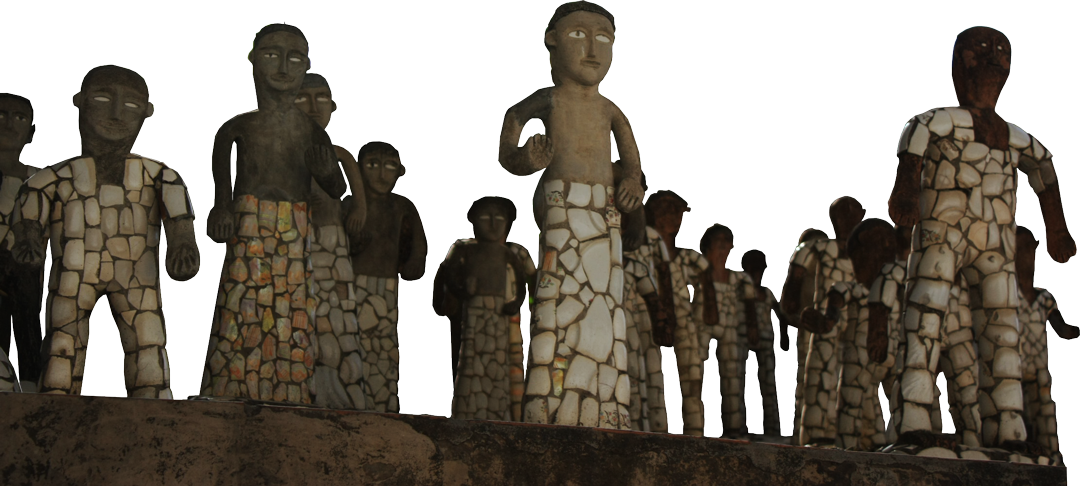
The early stages of the Rock Garden were deeply influenced by Nek Chand's childhood memories of rural life, the natural environment, and traditional Indian art forms. He created human figures, animals, and fantastical beings out of broken bangles, ceramic shards, bicycle frames, and other found objects. These figures were often inspired by the everyday scenes of village life—dancers, musicians, and animals, all rendered in a whimsical, otherworldly style. Over time, the Rock Garden expanded into a sprawling complex of courtyards, paths, waterfalls, and mosaic-covered walls, interspersed with sculptures and architectural features.
In 1975, the authorities in Chandigarh discovered Nek Chand's secret creation. Initially, the government planned to demolish the unauthorized structure, but public outcry saved the garden. By this time, Nek Chand's creation had gained attention, and people were captivated by the originality of his work. The garden, which had been built illegally on government land, was now seen as a unique cultural asset. Eventually, the government legitimized the project and appointed Nek Chand as the official caretaker of the Rock Garden, providing him with a salary and a team of workers to assist in the garden's expansion.
The Rock Garden soon became one of the most popular tourist attractions in Chandigarh and an icon of outsider art. Unlike the polished, orderly architecture of the rest of the city, the Rock Garden was a space of fantasy, spontaneity, and creativity. It was a place where the ordinary was transformed into the extraordinary, where waste became art, and where imagination had no limits.
Nek Chand's art was deeply personal and intuitive. He had no formal training, and he operated outside the established art world. His work was not shaped by the trends of contemporary art or by commercial considerations. Instead, it emerged from his own vision of what art could be—a vision that was inclusive, democratic, and deeply connected to the material reality of everyday life.
The Rock Garden of Chandigarh is an example of art brut, or “raw art,” a term coined by the French artist Jean Dubuffet to describe art created outside the boundaries of official culture. Nek Chand's work exemplifies the principles of art brut in its rejection of traditional aesthetics, its use of unconventional materials, and its roots in personal experience and imagination.
One of the central themes of the Rock Garden is the idea of transformation. Nek Chand took discarded materials—broken tiles, old bathroom fixtures, industrial waste—and transformed them into something magical and unexpected. This process of transformation reflects his belief in the potential for renewal and regeneration, even in the most unlikely of places. It also speaks to a larger ecological message about the need to rethink our relationship with waste and consumption.
The Rock Garden is also deeply connected to the idea of memory and nostalgia. Many of the sculptures in the garden are based on scenes from Nek Chand's childhood in rural Punjab. There are figures of villagers, dancers, animals, and deities, all rendered in a stylized almost dreamlike form. These sculptures evoke a sense of longing for a lost world, a world that was destroyed by the forces of modernity and urbanization. At the same time, the Rock Garden is a celebration of life and creativity, a testament to the enduring power of imagination in the face of loss and change.
Nek Chand's technique was entirely self-taught, and his approach to construction was as unconventional as his choice of materials. He used a wide variety of found objects—ceramics, stones, electrical waste, broken glass—and incorporated them into his sculptures and structure with little regard for traditional building methods. His work was characterized by its spontaneity and improvisation. He often built directly onto the site, without detailed plans or blueprints, allowing the materials and the landscape to guide the development of the garden.
Nek Chand's Rock Garden has had a profound impact on both Indian and international art. In India, his work has challenged conventional ideas about art and public space. The Rock Garden is not a traditional gallery or museum, but a living, evolving environment that blurs the boundaries between art, nature, and urban space. It has inspired generations of artists and architects to think creatively about the possibilities of using recycled materials and integrating art into the fabric of everyday life.
Internationally, Nek Chand's work has been celebrated as a pioneering example of outsider art. The Rock Garden has been featured in exhibitions and publications around the world, and Nek Chand himself has been invited to create installations in countries as far afield as the United States, Germany and Switzerland. In 1980, he was awarded the prestigious Padma Shri, one of India's highest civilian honors, in recognition of his artistic achievements.
The Rock Garden continues to attract millions of visitors from around the world, who come to marvel at its unique blend of art, architecture, and landscape. It remains a symbol of Chandigarh's creative spirit and a testament to the power of individual vision. Nek Chand's life and work are reminder that art can come from unexpected places, and that creativity knows no boundaries.
One of the most remarkable aspects of Nek Chand's legacy is the way in which his work has resonated with people from all walks of life. His art is not elitist or exclusive; it is accessible, playful, and rooted in the everyday. The Rock Garden is a place where anyone can connect with the joy of creation, whether they are children playing among the sculptures of artists seeking inspiration from Nek Chand's visionary imagination. After Nek Chand's death on June 12, 2015, the Rock Garden faced challenges in terms of preservation and maintenance. The garden, which had been a labour of love for his creator, required ongoing care and management to prevent deterioration. There were concerns about the long-term sustainability of the site, particularly given the fragile nature of many of the materials used in its construction.
In response to these challenges, various efforts have been made to preserve and protect the Rock Garden. Local authorities and cultural organizations have worked to ensure that the site is maintained and that Nek Chand's legacy is preserved for future generations. Conservation experts have been brought in to address issues related to the structural integrity of the garden and to develop strategies of preserving its unique materials.
At the same time, there has been a growing recognition of the importance of engaging the public in the ongoing life of the Rock Garden. Educational programs, workshops, and community events have been organized to involved people in the garden's future, encouraging them to see it not just as a static monument, but as a living evolving space.
Nek Chand's Rock Garden is a testament to the power of creativity, imagination, and resilience. It is a reminder that art can emerge from unexpected places and that beauty can be found in the most unconventional materials. His visionary transformation of discarded waste into a sprawling landscape of sculptures, mosaics, and structures reflects a deep belief in the potential of renewal and reinvention. The Rock Garden challenges traditional notions of art, emphasising that creativity knows no boundaries and can thrive even in the face of obstacles. Nek Chand's legacy inspires us to see the world differently, encouraging us to find beauty, possibility, and meaning in the overlooked and the forgotten.
Note: Photograph by Rahul Chaudhury
Nek Chand's early life was deeply shaped by the rural surroundings of his birth village. Growing up in pre-partition Punjab, he experienced the vibrant cultural landscape of northern India. His connection to nature and rural crafts was intrinsic, influenced by the verdant fields, the flow of rivers, and traditional art forms that he would later incorporate into his work. These early experiences left an indelible mark on his artistic sensibilities.
The Partition of India in 1947 drastically changed his life. Like millions of others, his family was forced to flee their ancestral home and migrate to the newly formed Indian state of Punjab. The displacement left Nek Chand with a sense of loss but also instilled in him a deep appreciation for the idea of preservation—preservation of memory, heritage, and material. This feeling would eventually become central to his work in the Rock Garden.
After the Partition, Nek Chand settled in Chandigarh, the capital city of Punjab and Haryana, designed by the famous Swiss-French architect Le Corbusier. Chandigarh, conceived as a symbol of modern India, was characterized by clean lines, concrete buildings, and planned sectors. Nek Chand was employed by the Public Works Department as a road inspector, but his creative vision transcended the technical nature of his job.
The idea of the Rock Garden took root in the early 1950s when Nek Chand began collecting materials from demolition sites around Chandigarh. At that time, the city was undergoing massive urban development, and debris from demolished villages and construction waste piled up across the landscape. Nek Chand saw potential in this decarded material. He began collecting broken ceramic, shattered glass, concrete fragments, and stones, and envisioned them as the foundation of an extraordinary creative endeavour.
His fascination with recycling and rescue came from his deep-rooted belief that everything had a second life. This idea went against the gran of the modernist philosophy that Chandigarh represented. Nek Chand was not merely salvaging waste; he was reimagining it, transforming it into a fantastical realm that defied conventional ideas of what constituted art.
In 1958, Nek Chand secretly began work on the Rock Garden on a patch of government land near Sukhna Lake, using discarded materials. For nearly a decade, his project remained hidden from the public eye, even as it grew in scope and ambition. By working at night and in his spare time, Nek Chand constructed an elaborate environment that combined sculpture, landscape, and architecture.
The early stages of the Rock Garden were deeply influenced by Nek Chand's childhood memories of rural life, the natural environment, and traditional Indian art forms. He created human figures, animals, and fantastical beings out of broken bangles, ceramic shards, bicycle frames, and other found objects. These figures were often inspired by the everyday scenes of village life—dancers, musicians, and animals, all rendered in a whimsical, otherworldly style. Over time, the Rock Garden expanded into a sprawling complex of courtyards, paths, waterfalls, and mosaic-covered walls, interspersed with sculptures and architectural features.
In 1975, the authorities in Chandigarh discovered Nek Chand's secret creation. Initially, the government planned to demolish the unauthorized structure, but public outcry saved the garden. By this time, Nek Chand's creation had gained attention, and people were captivated by the originality of his work. The garden, which had been built illegally on government land, was now seen as a unique cultural asset. Eventually, the government legitimized the project and appointed Nek Chand as the official caretaker of the Rock Garden, providing him with a salary and a team of workers to assist in the garden's expansion.
The Rock Garden soon became one of the most popular tourist attractions in Chandigarh and an icon of outsider art. Unlike the polished, orderly architecture of the rest of the city, the Rock Garden was a space of fantasy, spontaneity, and creativity. It was a place where the ordinary was transformed into the extraordinary, where waste became art, and where imagination had no limits.
Nek Chand's art was deeply personal and intuitive. He had no formal training, and he operated outside the established art world. His work was not shaped by the trends of contemporary art or by commercial considerations. Instead, it emerged from his own vision of what art could be—a vision that was inclusive, democratic, and deeply connected to the material reality of everyday life.
The Rock Garden of Chandigarh is an example of art brut, or “raw art,” a term coined by the French artist Jean Dubuffet to describe art created outside the boundaries of official culture. Nek Chand's work exemplifies the principles of art brut in its rejection of traditional aesthetics, its use of unconventional materials, and its roots in personal experience and imagination.
One of the central themes of the Rock Garden is the idea of transformation. Nek Chand took discarded materials—broken tiles, old bathroom fixtures, industrial waste—and transformed them into something magical and unexpected. This process of transformation reflects his belief in the potential for renewal and regeneration, even in the most unlikely of places. It also speaks to a larger ecological message about the need to rethink our relationship with waste and consumption.
The Rock Garden is also deeply connected to the idea of memory and nostalgia. Many of the sculptures in the garden are based on scenes from Nek Chand's childhood in rural Punjab. There are figures of villagers, dancers, animals, and deities, all rendered in a stylized almost dreamlike form. These sculptures evoke a sense of longing for a lost world, a world that was destroyed by the forces of modernity and urbanization. At the same time, the Rock Garden is a celebration of life and creativity, a testament to the enduring power of imagination in the face of loss and change.
Nek Chand's technique was entirely self-taught, and his approach to construction was as unconventional as his choice of materials. He used a wide variety of found objects—ceramics, stones, electrical waste, broken glass—and incorporated them into his sculptures and structure with little regard for traditional building methods. His work was characterized by its spontaneity and improvisation. He often built directly onto the site, without detailed plans or blueprints, allowing the materials and the landscape to guide the development of the garden.
Nek Chand's Rock Garden has had a profound impact on both Indian and international art. In India, his work has challenged conventional ideas about art and public space. The Rock Garden is not a traditional gallery or museum, but a living, evolving environment that blurs the boundaries between art, nature, and urban space. It has inspired generations of artists and architects to think creatively about the possibilities of using recycled materials and integrating art into the fabric of everyday life.
Internationally, Nek Chand's work has been celebrated as a pioneering example of outsider art. The Rock Garden has been featured in exhibitions and publications around the world, and Nek Chand himself has been invited to create installations in countries as far afield as the United States, Germany and Switzerland. In 1980, he was awarded the prestigious Padma Shri, one of India's highest civilian honors, in recognition of his artistic achievements.
The Rock Garden continues to attract millions of visitors from around the world, who come to marvel at its unique blend of art, architecture, and landscape. It remains a symbol of Chandigarh's creative spirit and a testament to the power of individual vision. Nek Chand's life and work are reminder that art can come from unexpected places, and that creativity knows no boundaries.
One of the most remarkable aspects of Nek Chand's legacy is the way in which his work has resonated with people from all walks of life. His art is not elitist or exclusive; it is accessible, playful, and rooted in the everyday. The Rock Garden is a place where anyone can connect with the joy of creation, whether they are children playing among the sculptures of artists seeking inspiration from Nek Chand's visionary imagination. After Nek Chand's death on June 12, 2015, the Rock Garden faced challenges in terms of preservation and maintenance. The garden, which had been a labour of love for his creator, required ongoing care and management to prevent deterioration. There were concerns about the long-term sustainability of the site, particularly given the fragile nature of many of the materials used in its construction.
In response to these challenges, various efforts have been made to preserve and protect the Rock Garden. Local authorities and cultural organizations have worked to ensure that the site is maintained and that Nek Chand's legacy is preserved for future generations. Conservation experts have been brought in to address issues related to the structural integrity of the garden and to develop strategies of preserving its unique materials.
At the same time, there has been a growing recognition of the importance of engaging the public in the ongoing life of the Rock Garden. Educational programs, workshops, and community events have been organized to involved people in the garden's future, encouraging them to see it not just as a static monument, but as a living evolving space.
Nek Chand's Rock Garden is a testament to the power of creativity, imagination, and resilience. It is a reminder that art can emerge from unexpected places and that beauty can be found in the most unconventional materials. His visionary transformation of discarded waste into a sprawling landscape of sculptures, mosaics, and structures reflects a deep belief in the potential of renewal and reinvention. The Rock Garden challenges traditional notions of art, emphasising that creativity knows no boundaries and can thrive even in the face of obstacles. Nek Chand's legacy inspires us to see the world differently, encouraging us to find beauty, possibility, and meaning in the overlooked and the forgotten.
Note: Photograph by Rahul Chaudhury